

8 Best Clockwise Alternatives for Smarter Scheduling
lockwise was a popular productivity tool designed to optimize team calendars by automatically moving flexible meetings, creating larger blocks of focus time, and helping teams coordinate schedules more efficiently.
Clockwise was acquired by Salesforce in 2025, and the standalone Clockwise product was subsequently shut down. That leaves existing users looking for alternatives, as well as teams searching for similar tools for calendar optimization, scheduling automation, and meeting coordination.
The best replacement depends on what you used Clockwise for. Some alternatives focus on protecting focus time and automatically organizing your calendar, while others can coordinate meetings directly, manage scheduling conversations, or provide flexible booking workflows.
Here are eight of the best Clockwise alternatives available today.
Clockwise Alternatives Comparison
| Tool | Best For | Key Strength |
|---|---|---|
| Skej | AI scheduling assistant | Handles real meeting coordination across email, text, Slack |
| OpenAssistant | Broad AI Assistant | Handles scheduling and additional work, highly customizable. |
| Motion | Task + meeting management | AI automatically organizes tasks and meetings |
| Calendly | Simple booking | Easy scheduling links and meeting automation |
| SavvyCal | Flexible scheduling links | More collaborative booking experience |
| Akiflow | Task + calendar management | Combines tasks and calendar into one interface |
| Sunsama | Daily planning | Structured day planning with task prioritization |
| Trevor AI | AI time blocking | Automatically schedules tasks into your calendar |
1. Skej

Skej approaches scheduling from a completely different angle than Clockwise. Instead of only optimizing calendars, Skej acts as an AI scheduling assistant that handles the actual coordination of meetings.
You can simply include Skej in an email thread, Slack conversation, or message and ask it to schedule a meeting. Skej reads the conversation, checks calendars, proposes times, and books the meeting automatically.
Because Skej operates directly within conversations, it eliminates the back-and-forth normally required to find a time.
This makes Skej particularly useful for founders, sales teams, recruiters, and anyone who schedules meetings with external contacts.
Key advantages:
• Works inside email, Slack, SMS, and WhatsApp
• Handles scheduling conversations automatically
• Manages rescheduling and follow-ups
• Coordinates across multiple calendars and time zones
2. OpenAssistant
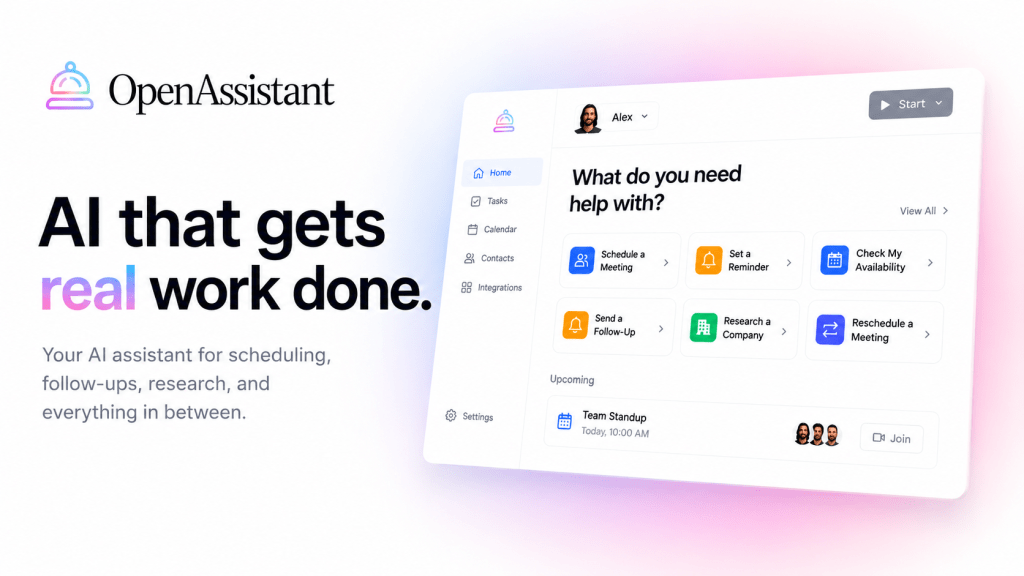
OpenAssistant is an AI assistant that handles scheduling alongside email, research, files, and other everyday work.
Instead of relying on booking links or requiring you to coordinate meetings manually, OpenAssistant can manage the scheduling process for you. It checks your calendar, communicates with participants, proposes available times, follows up when needed, handles rescheduling, and books meetings automatically.
Scheduling is just one of its capabilities. The same assistant can help manage your inbox, conduct research, prepare for meetings, work with files and documents, and complete tasks across connected applications. You can simply tell it what you need done and let it handle the work.
Key features include:
• AI-powered meeting coordination
• Automatic follow-ups and rescheduling
• Google and Outlook calendar support
• Email and inbox assistance
• Research and meeting preparation
• File and document creation and management
• Integrations with business tools and applications
OpenAssistant is a good fit for people who want the benefits of an AI scheduling assistant without using a tool dedicated only to scheduling. It combines meeting coordination with a broader AI assistant that can help get work done across your day.
3. Motion
Motion combines task management and calendar scheduling. Users create tasks with deadlines and priorities, and Motion automatically schedules them into available time slots.
The system constantly reorganizes your schedule when new meetings or tasks appear, helping maintain an optimized daily plan.
Motion is often used by professionals who want AI assistance managing both tasks and calendar time.
4. Calendly
Calendly is one of the most widely used scheduling tools available.
Instead of negotiating meeting times over email, users send a booking link that allows recipients to choose from available time slots. Calendly automatically creates calendar events and sends confirmations.
While simple and effective, many teams eventually look for solutions that feel more conversational and less transactional.
5. SavvyCal
SavvyCal is designed to make scheduling links feel more collaborative.
Recipients can overlay their own calendar on top of your availability to easily see where schedules align. This helps reduce friction when coordinating meetings.
SavvyCal is especially popular among founders, consultants, and independent professionals.
6. Akiflow
Akiflow is a productivity platform that combines task management and calendar scheduling.
Users can import tasks from tools like Slack, Gmail, Notion, or Trello and organize them into a structured schedule. The platform emphasizes time blocking and daily planning.
For professionals who want their tasks and calendar tightly integrated, Akiflow provides a centralized workflow.
7. Sunsama
Sunsama focuses on helping users plan their day more intentionally.
Each day begins with a guided planning session where users review tasks and schedule them into realistic time blocks. The platform encourages a slower, more thoughtful approach to productivity.
Sunsama integrates with many project management tools and helps teams maintain focus on meaningful work.
8. Trevor AI
Trevor AI is a lightweight tool designed for AI-assisted time blocking.
Users create tasks and Trevor automatically schedules them into open calendar slots. The system adjusts your schedule when tasks change or new events appear.
While simpler than some other platforms, Trevor provides an accessible way to experiment with AI-powered scheduling.
Choosing the Right Clockwise Alternative
Clockwise is best known for optimizing team calendars and protecting focus time. But depending on your workflow, another tool may provide a better fit.
If your biggest challenge is protecting time for deep work, tools like Reclaim or Sunsama may be helpful.
If you want AI assistance organizing tasks and planning your day, Motion or Akiflow may be worth exploring.
If your biggest frustration is coordinating meetings with other people, an AI scheduling assistant like Skej can remove the back-and-forth entirely.
Final Thoughts
Modern work requires more than just calendar optimization. Teams now need tools that can coordinate meetings, handle scheduling conversations, and adapt to constantly changing availability.
Clockwise solved part of this problem by optimizing calendars. But since shutting down, many former users are exploring alternatives that better match how meetings actually get scheduled.
Tools like Skej, OpenAssistant, and Motion each offer different approaches to managing time more effectively.
If you want to experience a more seamless way to schedule meetings, you can start using Skej for free and see what it’s like to have an AI assistant handle the coordination for you.
Make scheduling easier with Skej
Skej handles the back-and-forth while you focus on what's important.
Start Scheduling for FreeFree trial · No credit card required