

8 Best Motion Alternatives for Smarter Scheduling
Motion has become a popular tool for people who want help organizing their day. By combining task management, calendar scheduling, and AI planning, Motion automatically builds a schedule based on your tasks, deadlines, and meetings.
For many professionals, this approach works well. But Motion is not the perfect fit for everyone. Some users find the system too rigid, too expensive, or focused more on personal task planning than real-world scheduling with other people.
If you're exploring alternatives, there are several tools that offer different strengths. Some focus on AI scheduling assistants that handle meeting coordination. Others focus on calendar optimization or flexible booking tools.
Here are eight of the best Motion alternatives available today.
Motion Alternatives Comparison
| Tool | Best For | Key Strength |
|---|---|---|
| Skej | AI scheduling assistant | Handles real meeting coordination across email, text, Slack |
| Reclaim.ai | Calendar optimization | Automatically protects focus time and habits |
| OpenAssistant | Customizable general AI assistant | A customizable assistant for scheduling and broader work |
| Calendly | Simple booking | Easy scheduling links and meeting automation |
| SavvyCal | Flexible scheduling links | More collaborative booking experience |
| Akiflow | Task + calendar management | Combines tasks and calendar into one interface |
| Sunsama | Daily planning | Structured day planning with task prioritization |
| Trevor AI | AI time blocking | Automatically schedules tasks into your calendar |
1. Skej

Skej takes a very different approach from Motion. Instead of automatically scheduling your tasks, Skej focuses on the hardest part of calendar management: coordinating meetings with other people.
Skej works directly inside your conversations on email, Slack, text messages, and WhatsApp. When you ask Skej to set up a meeting, it reads the conversation, checks everyone's calendars, proposes times, and books the meeting.
Because Skej acts like a human assistant inside the thread, it eliminates the back-and-forth that normally comes with scheduling.
Skej is especially useful for founders, sales teams, recruiters, and anyone who schedules a large number of meetings.
Key advantages:
• Works directly in conversations
• Handles real scheduling negotiations
• Supports email, Slack, SMS, and WhatsApp
• Automatically manages rescheduling and follow-ups
2. Reclaim.ai
Reclaim focuses on protecting time in your calendar. Instead of helping you coordinate meetings with other people, Reclaim automatically schedules tasks, habits, and focus blocks.
For example, if you want to spend two hours per week writing or exercising, Reclaim will find open slots in your calendar and automatically place those activities.
The tool is popular with remote workers and productivity-focused professionals who want their calendar to automatically organize their priorities.
3. OpenAssistant
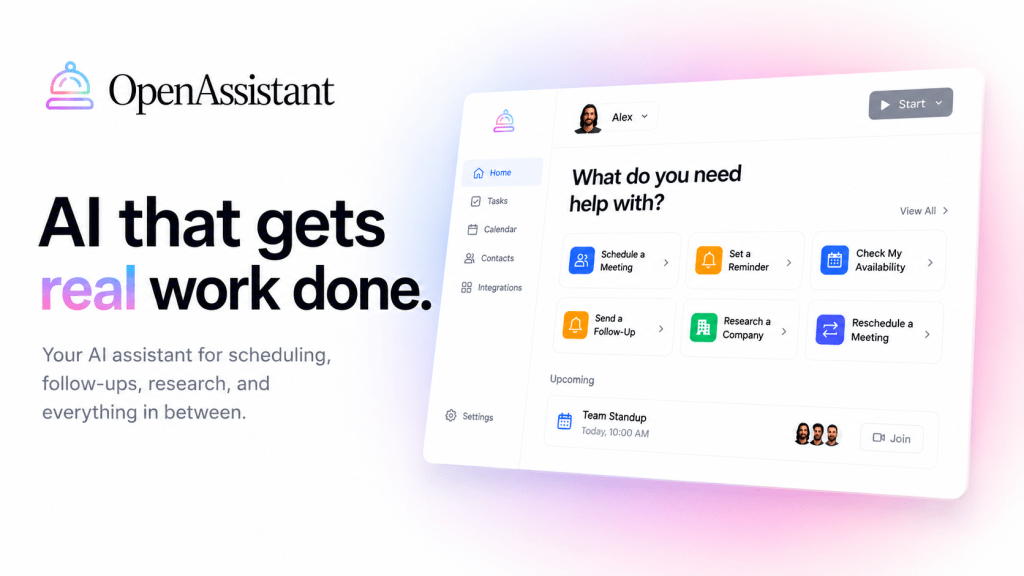
OpenAssistant is an AI assistant that handles scheduling alongside email, research, files, and other everyday work.
Instead of relying on booking links or requiring you to coordinate meetings manually, OpenAssistant can manage the scheduling process for you. It checks your calendar, communicates with participants, proposes available times, follows up when needed, handles rescheduling, and books meetings automatically.
Scheduling is just one of its capabilities. The same assistant can help manage your inbox, conduct research, prepare for meetings, work with files and documents, and complete tasks across connected applications. You can simply tell it what you need done and let it handle the work.
Key features include:
• AI-powered meeting coordination
• Automatic follow-ups and rescheduling
• Google and Outlook calendar support
• Email and inbox assistance
• Research and meeting preparation
• File and document creation and management
• Integrations with business tools and applications
OpenAssistant is a good fit for people who want the benefits of an AI scheduling assistant without using a tool dedicated only to scheduling. It combines meeting coordination with a broader AI assistant that can help get work done across your day.
4. Calendly
Calendly is one of the most widely known scheduling tools. Instead of negotiating meeting times over email, you send someone a booking link where they can choose a time that works.
Calendly supports multiple meeting types, automated reminders, and integrations with video conferencing platforms like Zoom and Google Meet.
While it simplifies booking, many users eventually want something more flexible that can handle conversations and rescheduling automatically.
5. SavvyCal
SavvyCal improves on traditional scheduling links by making them more collaborative.
Instead of forcing someone to pick from your availability alone, SavvyCal allows recipients to overlay their own calendar when choosing a meeting time. This makes it easier to see where both schedules align.
It’s a popular choice among founders and independent professionals who want a more polished scheduling experience.
6. Akiflow
Akiflow combines task management with calendar planning.
Users can import tasks from tools like Notion, Slack, Gmail, or Trello and schedule them directly onto their calendar. The platform is designed to help professionals turn tasks into structured daily plans.
If you like Motion’s task scheduling concept but want a different interface or workflow, Akiflow is often considered a strong alternative.
7. Sunsama
Sunsama focuses on daily planning and intentional work.
Each day, users review their tasks, decide what they realistically want to accomplish, and schedule those tasks directly into their calendar. The platform encourages a slower, more thoughtful planning process compared to fully automated tools.
It integrates with many project management platforms and helps teams stay focused on meaningful work rather than reactive scheduling.
8. Trevor AI
Trevor AI is a lighter AI-powered scheduling assistant that focuses primarily on time blocking.
Users create tasks and Trevor automatically finds time in their calendar to complete them. It can also adjust your schedule dynamically when priorities change.
While simpler than Motion, Trevor offers an accessible way to experiment with AI-assisted calendar planning.
Choosing the Right Motion Alternative
The best Motion alternative depends on what problem you're actually trying to solve.
If your biggest challenge is organizing tasks and protecting focus time, tools like Reclaim, Sunsama, or Akiflow may work well.
If your biggest frustration is coordinating meetings with other people, an AI scheduling assistant like Skej can remove the back-and-forth entirely.
Each platform approaches scheduling differently, so choosing the right one often depends on how you work and how your team collaborates.
Final Thoughts
Motion helped introduce many professionals to AI-assisted calendar management. But scheduling today involves more than just organizing tasks. It requires coordinating people, time zones, and conversations across multiple tools.
That’s why many teams are exploring alternatives that better match how work actually happens.
Tools like Skej, Reclaim, and OpenAssistant each solve different parts of the scheduling puzzle, giving professionals more control over their time and fewer headaches managing their calendars.
If you're ready to try a smarter way to schedule meetings, you can start using Skej for free and experience what it’s like to have an AI assistant handle scheduling for you.
Make scheduling easier with Skej
Skej handles the back-and-forth while you focus on what's important.
Start Scheduling for FreeFree trial · No credit card required