

8 Best Reclaim Alternatives for Smarter Scheduling
Reclaim.ai has become a popular tool for people trying to take back control of their calendar. It automatically schedules tasks, protects focus time, and reorganizes meetings to create a more balanced workday.
For many professionals, this kind of calendar optimization can be extremely helpful.
But Reclaim isn’t always the right fit. Some teams want scheduling to happen automatically inside conversations. Others want tools that focus more on coordinating meetings rather than rearranging their calendars.
If you're exploring other options, there are several strong Reclaim alternatives available today.
Below are some of the best tools to consider.
Best Reclaim Alternatives at a Glance
| Tool | Best For | Key Advantage |
|---|---|---|
| Skej | AI scheduling automation | Schedules meetings directly in email, Slack, SMS, and WhatsApp |
| Calendly | Booking links | Simple scheduling pages for sharing availability |
| Motion | Task + meeting management | AI automatically organizes tasks and meetings |
| OpenAssistant | General work & scheduling | Highly customizable AI assistant for scheduling and more |
| SavvyCal | Personalized scheduling | Calendar overlay makes finding mutual times easier |
| Doodle | Group scheduling | Poll-based scheduling for multiple participants |
| HubSpot Scheduler | Sales teams | Scheduling integrated directly with CRM |
| Chili Piper | Revenue teams | Instant lead routing and demo booking |
1. Skej

Skej takes a different approach to scheduling than Reclaim. Instead of focusing on rearranging your calendar, Skej automates the process of coordinating meetings with other people.
You simply add Skej to an email thread or send it a message through Slack, SMS, or WhatsApp, and its human-like AI assistants handles the rest. It checks calendars, proposes meeting times, follows up if someone doesn’t respond, and updates the calendar once a time is confirmed.
Because Skej works conversationally, it feels more like having a human assistant helping manage your schedule. It can interpret natural language messages like “free Thursday morning,” read screenshots of calendars, and even process someone else’s scheduling link to find mutual availability.
For teams that spend a lot of time coordinating meetings with clients or external contacts, Skej can remove most of the manual work involved in scheduling.
Best for: Teams that want AI-driven scheduling instead of manual coordination.
2. Calendly
Calendly is one of the most widely used scheduling tools in the world.
Instead of coordinating meeting times manually, users send a booking link that displays their available time slots. The other person simply selects a time that works, and the meeting is automatically added to both calendars.
Calendly is known for its simplicity and reliability. It integrates with major calendar platforms and offers customization options for meeting types, buffers, and scheduling preferences.
While it doesn’t automate the conversation around scheduling the way AI assistants do, it remains one of the easiest tools to start using.
Best for: Individuals and teams who prefer simple booking links.
3. Motion
Motion combines scheduling with task and project management.
The platform automatically organizes tasks, deadlines, and meetings inside your calendar. Motion’s AI prioritizes work based on urgency and dynamically rearranges your schedule when new tasks or meetings appear.
Because it blends scheduling with project management, Motion is often used by teams who want a single system to manage both work and meetings.
Best for: Teams that want scheduling combined with task management.
4. OpenAssistant
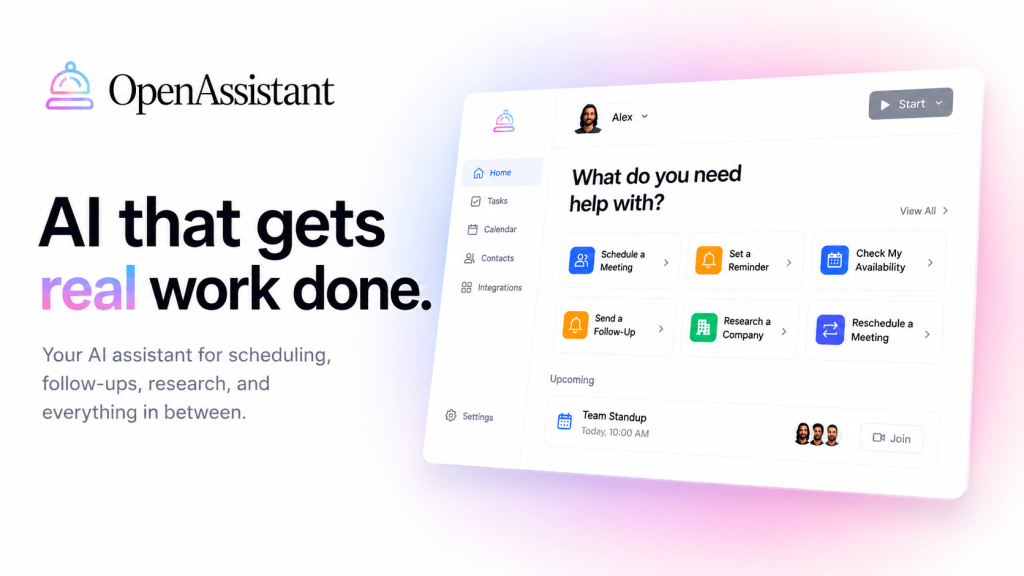
OpenAssistant is an AI assistant that handles scheduling alongside email, research, files, and other everyday work.
Instead of relying on booking links or requiring you to coordinate meetings manually, OpenAssistant can manage the scheduling process for you. It checks your calendar, communicates with participants, proposes available times, follows up when needed, handles rescheduling, and books meetings automatically.
Scheduling is just one of its capabilities. The same assistant can help manage your inbox, conduct research, prepare for meetings, work with files and documents, and complete tasks across connected applications. You can simply tell it what you need done and let it handle the work.
Key features include:
• AI-powered meeting coordination
• Automatic follow-ups and rescheduling
• Google and Outlook calendar support
• Email and inbox assistance
• Research and meeting preparation
• File and document creation and management
• Integrations with business tools and applications
OpenAssistant is a good fit for people who want the benefits of an AI scheduling assistant without using a tool dedicated only to scheduling. It combines meeting coordination with a broader AI assistant that can help get work done across your day.
Best for: Teams that want a customizable assistant that can help with a broad range of work throughout their day.
5. SavvyCal
SavvyCal is a modern scheduling tool designed to improve the booking link experience.
One of its most distinctive features is the ability for recipients to overlay their own calendar when viewing available time slots. This makes it easier to find mutual availability without switching between calendars.
SavvyCal also allows more customization and personalization than traditional scheduling links, which can create a more polished experience when sharing scheduling pages with clients.
Best for: Professionals who want a more flexible booking page.
6. Doodle
Doodle is one of the longest-standing scheduling tools and remains popular for coordinating meetings with larger groups.
Instead of booking links, Doodle uses polls where participants vote on available meeting times. Once everyone responds, the organizer selects the option that works best.
This approach works particularly well for organizing meetings across large teams or events where availability varies widely.
Best for: Scheduling meetings with multiple participants.
7. HubSpot Meeting Scheduler
HubSpot offers a meeting scheduling tool built directly into its CRM platform.
Sales teams can embed scheduling links in emails, track meeting activity inside the CRM, and automatically update contact records when meetings are booked.
For companies already using HubSpot, this tool can replace standalone scheduling apps while keeping everything connected to the sales pipeline.
Best for: Sales teams using HubSpot.
8. Chili Piper
Chili Piper is designed specifically for revenue teams and inbound lead scheduling.
Instead of asking prospects to schedule a meeting later, Chili Piper allows visitors to book demos immediately after submitting a form or requesting information.
This approach helps sales teams respond faster to inbound leads and increases the chances of converting interested prospects into customers.
Best for: Sales organizations focused on inbound lead routing.
How to Choose the Right Reclaim Alternative
Choosing the right Reclaim alternative depends on how you want scheduling to work.
If your goal is better time management and automatic focus time, tools like Motion or Clockwise may offer similar benefits to Reclaim.
If you prefer the simplicity of booking links, Calendly or SavvyCal may be a good fit.
But if you want to eliminate the scheduling back-and-forth entirely, an AI scheduling assistant like Skej can coordinate meetings automatically inside conversations.
Instead of rearranging your calendar after meetings appear, Skej helps ensure meetings get scheduled smoothly in the first place.
Try a Smarter Way to Schedule Meetings
Scheduling meetings shouldn’t require constant back-and-forth messages or manual coordination.
With Skej, an AI assistant can handle the entire scheduling process directly inside email, Slack, WhatsApp, or text.
You can start a 7-day free trial and experience what it feels like when meeting coordination happens automatically.
Make scheduling easier with Skej
Skej handles the back-and-forth while you focus on what's important.
Start Scheduling for FreeFree trial · No credit card required