
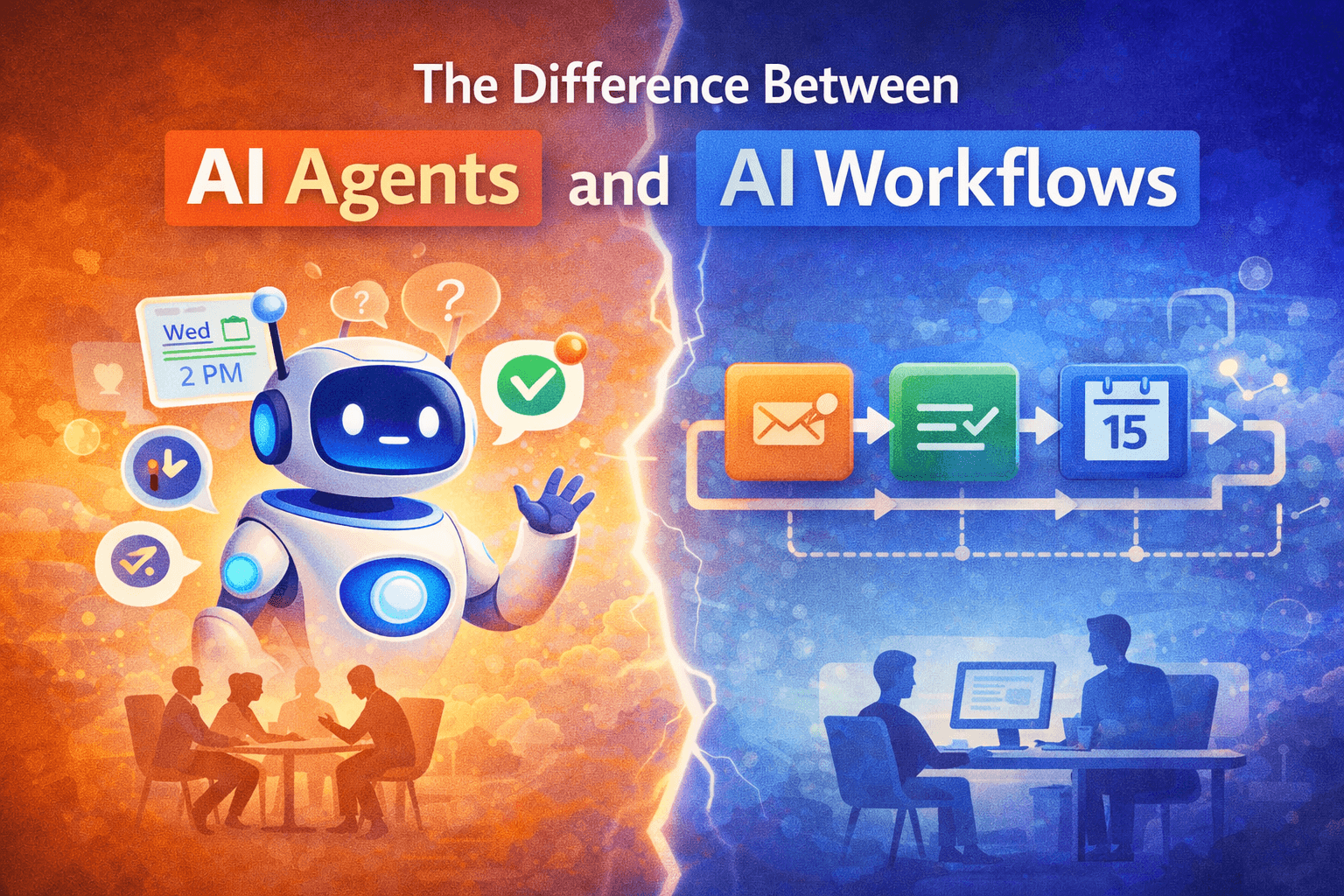
The Difference Between AI Agents and AI Workflows
The term “AI agent” is everywhere right now.
Every week there’s a new product claiming to be powered by agents that can automate work, replace tools, or run entire processes autonomously. But when you look closely at many of these products, something becomes clear:
Most of them aren’t actually agents.
They’re workflows.
Understanding the difference between an AI workflow and an AI agent is important because the two solve very different problems. Workflows automate predictable steps. Agents operate in messy environments where decisions, negotiation, and adaptation are required.
As AI systems move from simple automation toward real-world coordination, that distinction matters more than ever.
What Is an AI Workflow?
An AI workflow is a structured sequence of steps where the system performs a defined task.
Think of it as automation with some intelligence layered in.
A workflow typically looks something like this:
Input → processing → output
For example:
An email arrives → AI extracts meeting details → a calendar event is created.
Or:
A support ticket arrives → AI categorizes the issue → the ticket is routed to the correct team.
These systems can be extremely useful, and AI makes them more flexible than traditional automation. But they still operate within a predefined structure. The inputs are expected, the outputs are predictable, and the system doesn’t need to negotiate or adapt to unexpected situations.
In other words, workflows are great when the task is clear.
What Is an AI Agent?
An AI agent operates very differently.
Instead of following a rigid set of steps, an agent is responsible for achieving an outcome. To do that, it must interpret information, make decisions, communicate with people or systems, and adjust when circumstances change.
Agents operate in environments where the inputs are incomplete and the path to the outcome isn’t predetermined.
For example, imagine scheduling a meeting between several people.
At first glance, that might seem like a simple workflow. But in reality, scheduling often requires:
Interpreting vague responses like “Wednesday afternoon works.”
Managing time zones.
Handling partial availability.
Following up when someone doesn’t respond.
Negotiating alternative times when conflicts appear.
Rescheduling when plans change.
This isn’t a simple automation pipeline. It’s an ongoing conversation with constraints, preferences, and evolving information.
That’s the kind of environment where agents are required.
Why the Distinction Matters
The difference between workflows and agents becomes clearer when you look at the type of problems each can solve.
Workflows excel when the steps are known in advance. Tasks like document processing, summarizing emails, routing support tickets, or extracting information from structured inputs are ideal for workflow automation.
Agents become necessary when the system must interact with people, adapt to uncertainty, or coordinate multiple parties toward an outcome.
In many cases, what companies market as “AI agents” are actually workflows with a conversational interface. The system may respond to natural language, but underneath it is still executing a fixed set of rules.
True agents require more flexibility. They must reason about constraints, maintain context across interactions, and make decisions when the path forward isn’t obvious.
Scheduling Is a Natural Use Case for AI Agents
Meeting scheduling is a surprisingly good example of why agents are needed.
At a surface level, it looks simple: find an open time and book a meeting. But in practice, scheduling involves constant negotiation and adaptation.
People respond with partial information.
Availability changes.
Meetings need to be rescheduled.
Time zones create confusion.
New participants get added to threads.
Human assistants handle these situations by interpreting context, communicating politely, and adjusting plans as new information arrives.
That’s exactly the kind of problem AI agents are designed to solve.
Instead of forcing people into rigid booking links or predefined forms, an AI scheduling assistant can participate in the conversation itself. It can propose times, interpret responses, follow up when necessary, and update calendars automatically.
The system’s goal isn’t just to execute steps. It’s to reach an outcome: getting the meeting booked.
Why Many “AI Agents” Are Still Workflows
Part of the confusion around AI agents comes from how new the category still is.
Many products that call themselves agents today are actually combinations of language models and automation pipelines. They can understand natural language inputs, but the actions they perform are still defined by fixed workflows.
There’s nothing wrong with that approach. Workflows remain incredibly useful for many types of automation.
But real agents appear when systems move beyond static steps and begin operating in dynamic environments where decisions must be made along the way.
Communication-heavy tasks are often where this difference becomes most visible.
The Future of AI Will Combine Both
In reality, the future of AI systems will likely blend both models.
Workflows will continue to power structured automation where tasks are predictable and repeatable. Agents will take on more open-ended responsibilities where coordination, decision-making, and adaptation are required.
You can think of workflows as the assembly line of automation, and agents as the operators who handle everything that doesn’t fit neatly into the line.
As AI tools become more capable, we’ll likely see agents orchestrating workflows behind the scenes, combining the strengths of both approaches.
From Automation to Coordination
The biggest shift happening in AI right now is a move from simple automation toward coordination.
Instead of just processing data or generating content, AI systems are beginning to manage real-world processes that involve multiple people, changing constraints, and ongoing communication.
Those environments are messy, and they’re exactly where agents shine.
Scheduling is just one example. But it illustrates a broader pattern: the more human interaction a task requires, the more likely it is that true AI agents will eventually take it over.
Tools that can operate naturally within conversations, adapt to real-world constraints, and quietly handle coordination behind the scenes will define the next generation of AI assistants.
Make scheduling easier with Skej
Skej handles the back-and-forth while you focus on what's important.
Start Scheduling for FreeFree trial · No credit card required