Skej
Assistants
Product
Solutions
For Teams
Switch from Calendly
Pricing
← Back to Blog
Why Scheduling Across Time Zones Is Harder Than It Seems

Why Scheduling Across Time Zones Is Harder Than It Seems

Justin Canetti•2026-03-18

As teams become more distributed, scheduling meetings across time zones has become a normal part of work.

A meeting between New York and San Francisco is routine. Add someone in London, and it becomes a little more complicated. Include a teammate in Asia, and suddenly the scheduling math starts to break down.

What looks like a simple task—finding a time for everyone to meet—can quickly turn into a frustrating coordination problem.

Time Zones Create Hidden Complexity

When everyone works in the same location, scheduling is straightforward. A time that works for one person likely works for everyone else.

Across time zones, the same time can mean very different things.

A meeting scheduled for:

  • 9:00 AM in New York
  • 6:00 AM in San Francisco
  • 10:00 PM in Singapore

What looks reasonable to one participant might fall far outside normal working hours for someone else.

As the number of participants increases, it becomes harder to balance these constraints fairly.

The Challenge of Fair Meeting Times

When meetings span continents, someone often has to compromise.

For example:

  • West Coast teams may need early mornings to meet Europe
  • East Coast teams may need late evenings to meet Asia
  • Global teams may rotate meeting times to distribute the inconvenience

But keeping track of these tradeoffs manually can be difficult.

Without realizing it, teams sometimes end up scheduling recurring meetings that consistently disadvantage the same group of participants.

Daylight Saving Time Makes It Worse

Even when teams become comfortable with time zone differences, daylight saving time can introduce new confusion.

Not all regions change clocks at the same time. Some don’t observe daylight saving time at all.

This means the difference between two locations may shift during the year.

A meeting that worked perfectly for months can suddenly move an hour earlier or later for some participants.

These changes often catch people off guard.

Calendar Math Is Surprisingly Hard

When scheduling across multiple time zones, people often try to mentally convert times:

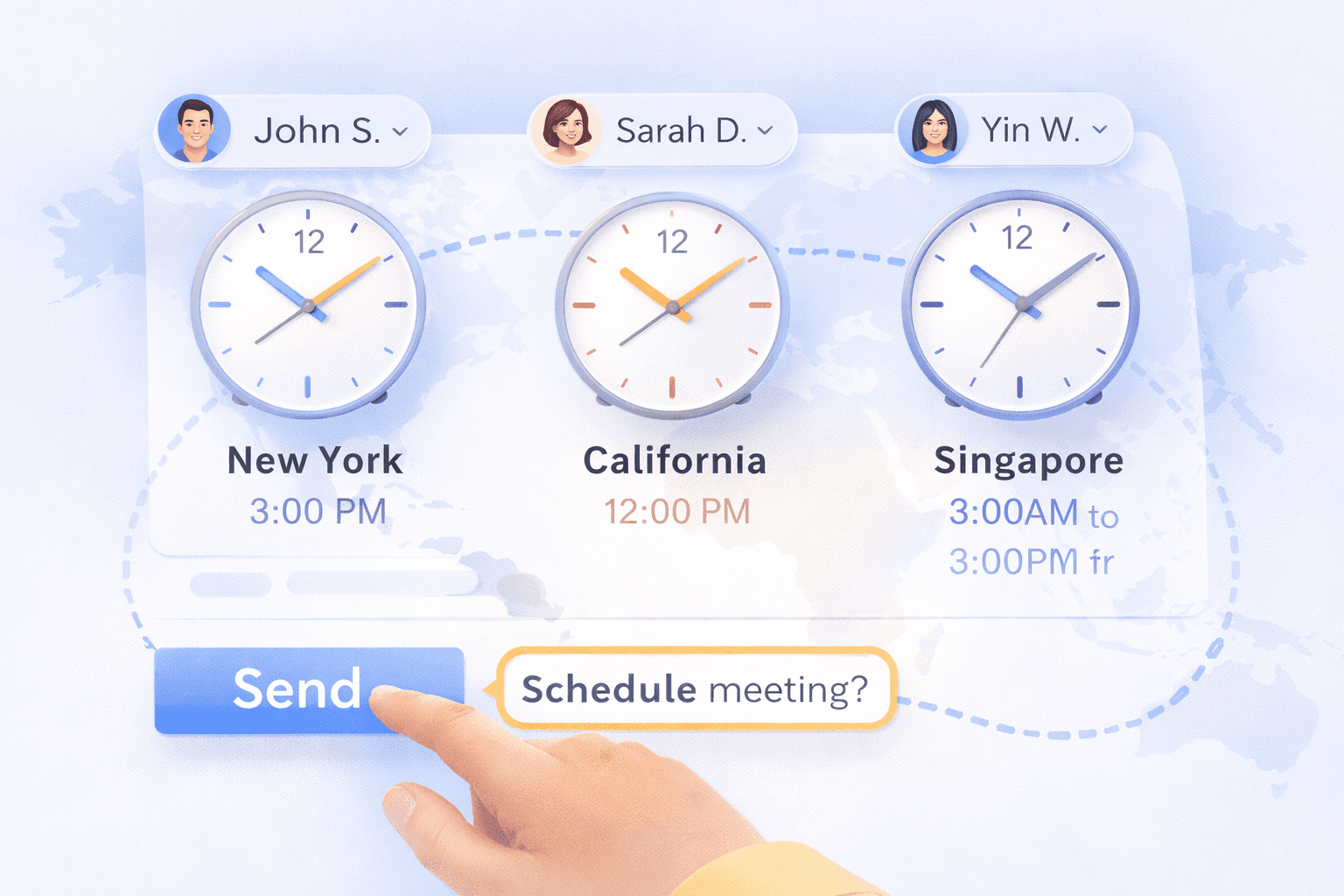
  • “If it’s 3 PM here, that’s 12 PM in California.”
  • “Which means it’s… midnight in Singapore?”

It’s easy to make mistakes, especially when multiple people are involved.

And mistakes often lead to missed meetings or awkward rescheduling.

Why AI Assistants Are Useful for Time Zone Scheduling

AI scheduling assistants can help reduce this complexity.

Instead of manually calculating time differences and negotiating availability, the assistant can:

  • analyze each participant’s calendar
  • consider their local time zone
  • propose meeting times that fit within normal working hours
  • flag options that fall outside typical schedules

For example, if a meeting involves participants in California, New York, and Tokyo, the assistant can automatically identify windows that minimize inconvenience for everyone.

In some cases, it may even suggest extending working hours slightly when no perfect overlap exists.

Helping Teams Coordinate More Thoughtfully

One advantage of automated scheduling is that it can highlight situations that might otherwise go unnoticed.

If the only available meeting time requires someone to join at 6:00 AM or 11:00 PM, the assistant can flag that constraint and prompt participants to confirm whether it’s acceptable.

This helps teams make more thoughtful decisions about scheduling rather than accidentally creating unreasonable meeting times.

How AI Assistants Like Skej Help Solve Time Zone Scheduling

This is where AI scheduling assistants become especially useful.

Instead of manually calculating time differences and negotiating availability, an assistant can analyze calendars across participants and identify realistic meeting windows automatically.

Tools like Skej go a step further by learning patterns over time.

For example, Skej can recognize:

  • each participant’s local time zone
  • typical working hours
  • when someone regularly accepts early or late meetings
  • recurring availability patterns

Using that context, Skej can proactively suggest meeting times that make sense for everyone involved.

If a meeting includes participants in California, New York, and Singapore, Skej can automatically propose options that balance the time difference rather than forcing someone into an unreasonable hour.

When no perfect overlap exists, Skej can also highlight when a proposed time would fall outside normal working hours so participants can decide whether they’re comfortable making that exception.

Instead of people manually juggling time conversions and calendars, the assistant quietly handles the logistics in the background.

What once felt like simple calendar coordination is now a small coordination problem. AI assistants like Skej are designed to solve that problem automatically, helping teams spend less time calculating time zones and more time focusing on the meeting itself.

As teams become more global, scheduling will increasingly involve balancing availability across continents and time zones.

Product

Email AssistantBooking LinkTextingSlack & TeamsFollow-UpsAdd to CalendarSmart Options

Solutions

For InvestorsFor FoundersFor SalesFor RecruitersSwitch from Calendly

For Teams

Internal MeetingsSlack & TeamsSecurity & ComplianceIT Admin ControlsCustom Assistants

Company

CompanyUpdatesBlogSimon BaumerContact

Resources

PricingFAQTermsPrivacyCookiesTrust Center

Get Started

Product

Email AssistantBooking LinkTextingSlack & TeamsFollow-UpsAdd to CalendarSmart Options

Solutions

For InvestorsFor FoundersFor SalesFor RecruitersSwitch from Calendly

For Teams

Internal MeetingsSlack & TeamsSecurity & ComplianceIT Admin ControlsCustom Assistants

Company

CompanyUpdatesBlogSimon BaumerContact

Resources

PricingFAQTermsPrivacyCookiesTrust Center

Get Started

Designed by 3Gen Internet Corporation in New York

Skej
Assistants
Product
Solutions
For Teams
Switch from Calendly
Pricing
← Back to Blog
Why Scheduling Across Time Zones Is Harder Than It Seems

Why Scheduling Across Time Zones Is Harder Than It Seems

Justin Canetti•2026-03-18

As teams become more distributed, scheduling meetings across time zones has become a normal part of work.

A meeting between New York and San Francisco is routine. Add someone in London, and it becomes a little more complicated. Include a teammate in Asia, and suddenly the scheduling math starts to break down.

What looks like a simple task—finding a time for everyone to meet—can quickly turn into a frustrating coordination problem.

Time Zones Create Hidden Complexity

When everyone works in the same location, scheduling is straightforward. A time that works for one person likely works for everyone else.

Across time zones, the same time can mean very different things.

A meeting scheduled for:

  • 9:00 AM in New York
  • 6:00 AM in San Francisco
  • 10:00 PM in Singapore

What looks reasonable to one participant might fall far outside normal working hours for someone else.

As the number of participants increases, it becomes harder to balance these constraints fairly.

The Challenge of Fair Meeting Times

When meetings span continents, someone often has to compromise.

For example:

  • West Coast teams may need early mornings to meet Europe
  • East Coast teams may need late evenings to meet Asia
  • Global teams may rotate meeting times to distribute the inconvenience

But keeping track of these tradeoffs manually can be difficult.

Without realizing it, teams sometimes end up scheduling recurring meetings that consistently disadvantage the same group of participants.

Daylight Saving Time Makes It Worse

Even when teams become comfortable with time zone differences, daylight saving time can introduce new confusion.

Not all regions change clocks at the same time. Some don’t observe daylight saving time at all.

This means the difference between two locations may shift during the year.

A meeting that worked perfectly for months can suddenly move an hour earlier or later for some participants.

These changes often catch people off guard.

Calendar Math Is Surprisingly Hard

When scheduling across multiple time zones, people often try to mentally convert times:

  • “If it’s 3 PM here, that’s 12 PM in California.”
  • “Which means it’s… midnight in Singapore?”

It’s easy to make mistakes, especially when multiple people are involved.

And mistakes often lead to missed meetings or awkward rescheduling.

Why AI Assistants Are Useful for Time Zone Scheduling

AI scheduling assistants can help reduce this complexity.

Instead of manually calculating time differences and negotiating availability, the assistant can:

  • analyze each participant’s calendar
  • consider their local time zone
  • propose meeting times that fit within normal working hours
  • flag options that fall outside typical schedules

For example, if a meeting involves participants in California, New York, and Tokyo, the assistant can automatically identify windows that minimize inconvenience for everyone.

In some cases, it may even suggest extending working hours slightly when no perfect overlap exists.

Helping Teams Coordinate More Thoughtfully

One advantage of automated scheduling is that it can highlight situations that might otherwise go unnoticed.

If the only available meeting time requires someone to join at 6:00 AM or 11:00 PM, the assistant can flag that constraint and prompt participants to confirm whether it’s acceptable.

This helps teams make more thoughtful decisions about scheduling rather than accidentally creating unreasonable meeting times.

How AI Assistants Like Skej Help Solve Time Zone Scheduling

This is where AI scheduling assistants become especially useful.

Instead of manually calculating time differences and negotiating availability, an assistant can analyze calendars across participants and identify realistic meeting windows automatically.

Tools like Skej go a step further by learning patterns over time.

For example, Skej can recognize:

  • each participant’s local time zone
  • typical working hours
  • when someone regularly accepts early or late meetings
  • recurring availability patterns

Using that context, Skej can proactively suggest meeting times that make sense for everyone involved.

If a meeting includes participants in California, New York, and Singapore, Skej can automatically propose options that balance the time difference rather than forcing someone into an unreasonable hour.

When no perfect overlap exists, Skej can also highlight when a proposed time would fall outside normal working hours so participants can decide whether they’re comfortable making that exception.

Instead of people manually juggling time conversions and calendars, the assistant quietly handles the logistics in the background.

What once felt like simple calendar coordination is now a small coordination problem. AI assistants like Skej are designed to solve that problem automatically, helping teams spend less time calculating time zones and more time focusing on the meeting itself.

As teams become more global, scheduling will increasingly involve balancing availability across continents and time zones.

Product

Email AssistantBooking LinkTextingSlack & TeamsFollow-UpsAdd to CalendarSmart Options

Solutions

For InvestorsFor FoundersFor SalesFor RecruitersSwitch from Calendly

For Teams

Internal MeetingsSlack & TeamsSecurity & ComplianceIT Admin ControlsCustom Assistants

Company

CompanyUpdatesBlogSimon BaumerContact

Resources

PricingFAQTermsPrivacyCookiesTrust Center

Get Started

Product

Email AssistantBooking LinkTextingSlack & TeamsFollow-UpsAdd to CalendarSmart Options

Solutions

For InvestorsFor FoundersFor SalesFor RecruitersSwitch from Calendly

For Teams

Internal MeetingsSlack & TeamsSecurity & ComplianceIT Admin ControlsCustom Assistants

Company

CompanyUpdatesBlogSimon BaumerContact

Resources

PricingFAQTermsPrivacyCookiesTrust Center

Get Started

Designed by 3Gen Internet Corporation in New York